
You are in the middle of a biologics production run that is high stakes. Your group has been growing cells for weeks. This lot is a new vaccine, and the pressure (literally and figuratively) is on. You’ve finally hit the downstream processing stage. The quality of the separation of your target proteins against all the rest depends on how well you can do it.
Then the pressure spikes. Flow drops to almost nothing. Your membrane is fouled, and the batch consistency you’ve been protecting so carefully is suddenly hanging by a thread.
If you work in biotech filtration, that scenario probably sounds familiar. The truth is, picking the right ultrafiltration system goes far beyond ticking boxes on a procurement form. It is a choice that will directly influence whether your product will come out of the process intact. Now, then, we shall see what really counts when making that call.
What Makes Ultrafiltration Equipment Suitable for Biotech Applications
Consider ultrafiltration technology as an extremely fine molecular sieve. It uses a semi-permeable membrane to sort molecules by size and molecular weight, which, in biologics manufacturing, is exactly what you need when concentrating proteins or stripping out smaller impurities.
The Ultrafiltration System Working Principle
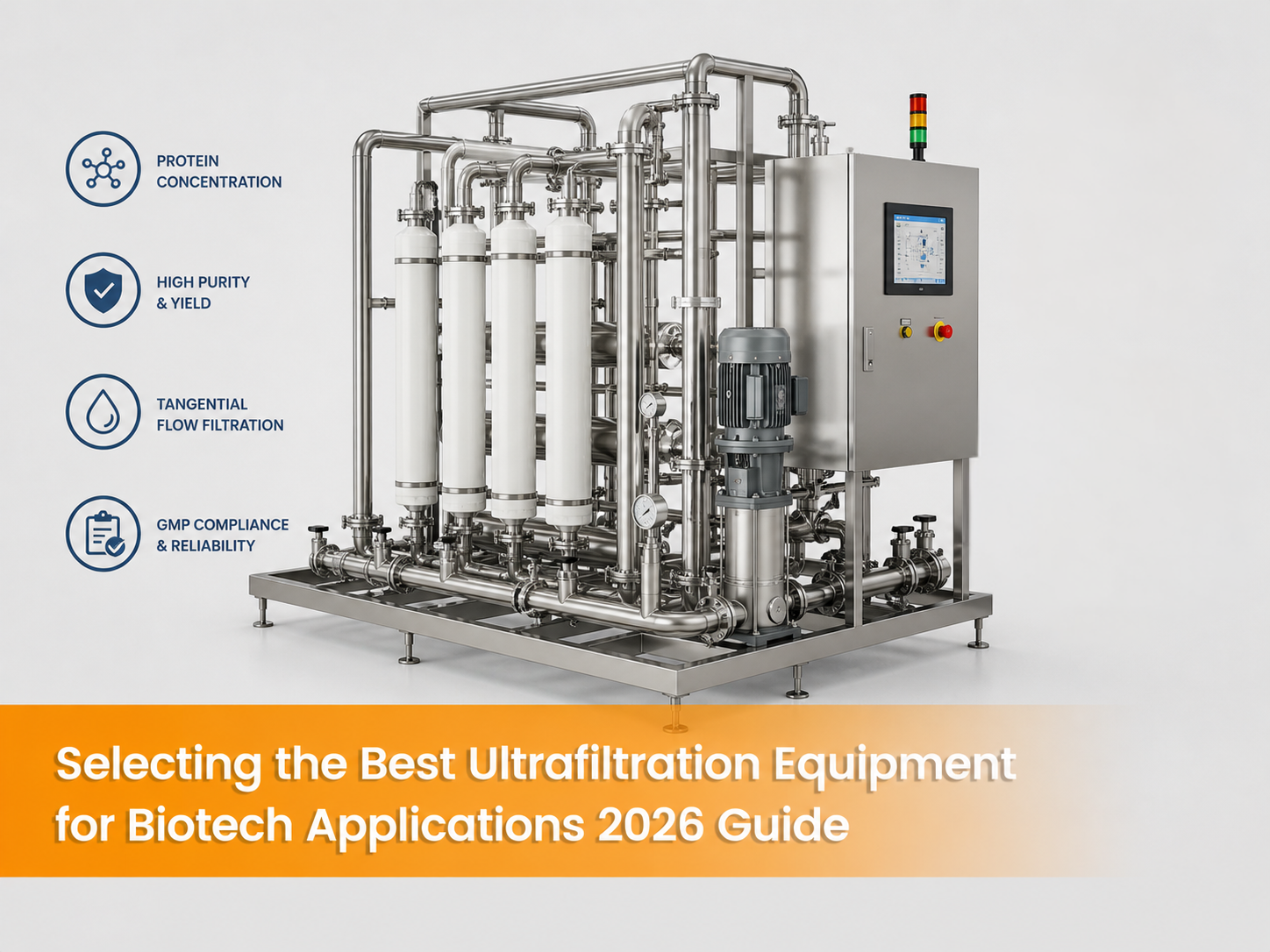
Here’s what makes it different from conventional filtration: most industrial ultrafiltration systems used in biotech don’t push fluid straight through. Instead, they use tangential flow filtration (TFF) systems.
A TFF system has the fluid flowing parallel to the membrane surface and not directly into the membrane. It is that lateral sweeping motion that prevents the piling up of solids and clogging of things. The flow on the other side of the membrane is your permeate flow; your concentrated product remains in circulation in the retentate loop.
Why It Matters: The High Stakes of Biotech.
Close enough is not a category in vaccine manufacturing or making monoclonal antibodies. This is what is literally at stake when you select your ultrafiltration membrane filters:
- Purity of the product: Trace impurities can affect a whole batch of biologics,there is no half credit in this case.
- Yield Recovery: No one would like to see a costly product go down the drain. The correct filtration solutions will ensure that you are sure that what you are recovering is what you are putting in.
- Regulatory Safety: Your equipment must be able to withstand the test of time. Compliance requirements such as 21 CFR Part 11 for electronic records must be considered, particularly in system software and data handling. The same thing applies to sterile processing standards.
Membrane Configurations and Ultrafiltration System Types.
1. Hollow Fiber Membranes
They are simply a bunch of small tubes. They can work with high solids, and are particularly optimally adapted to cell harvest and large-volume runs, so they are commonly used in applications like cell harvest and continous harvesting.
2. Flat Sheet (Cassettes)
3. Spiral Wound Membranes
You’ll find these more often in industrial ultrafiltration units for biotech, mostly used in dealing with water treatment or less sensitive separations.
Key Factors to Consider When Choosing the Best Ultrafiltration Systems
The following are some of the main considerations that should be made when selecting the most appropriate ultrafiltration systems. When comparing the manufacturers of ultrafiltration membranes in India, remember to have this checklist with you:
- Molecular Weight Cut-Off (MWCO): The pores need to be small enough to retain your target molecule but open enough to pass the impurities you’re trying to shed.
- Material Compatibility: The membrane uf material has to withstand your cleaning chemistry without reacting with your product.
- Scalability: Whatever works in the lab needs to translate to full biologics production without reinventing the process.
- Automation: Anything contemporary ought to provide you with real-time transmembrane pressure (TMP) information – otherwise, continue searching.
Common Mistakes to Avoid When Selecting Ultrafiltration Systems
- Overlooking Batch-to-Batch Consistency: A single clean run is honestly just a good start. The best industrial ultrafiltration systems perform the same way on run 100 as they did on run one.
- Underestimating Cleaning Needs: A system that’s difficult to clean is a system that will hit you with membrane fouling costs you didn’t budget for.
- Choosing Price Over Support: In biotech filtration, when something goes sideways mid-process, you need a manufacturer who picks up the phone — not one who disappears after the sale.
How the Right Ultrafiltration System Impacts Product Quality and Process Efficiency
Working through a search for ultrafiltration applications in biopharma solutions? Here’s a practical sequence:
- Define your goal: Start simple. Is this for sterile filtration, protein concentration, or buffer exchange? The answer shapes everything downstream.
- Calculate your volume: Know your batch size before you size your membrane uf area. Guessing here costs you later.
- Test at small scale: Run lab-scale trials first. You want to catch product binding or shear sensitivity issues before they show up in a full batch.
- Check for Compliance: The hardware and software both need to meet global pharmaceutical standards — not just one of the two.
- Evaluate the Manufacturer: Seek out ultrafiltration membrane manufacturers in India who actually understand the demands of the biotech environment, not just the specs on paper.
Questions to Ask Before You Decide
Ahead of you investing in any new ultrafiltration equipment, ask your vendor the following four questions:
- Is it a continuous biomanufacturing system, or is it batch only?
- What’s the realistic membrane lifespan given our specific cleaning protocol?
- Does the control software support 21 CFR Part 11 compliance and data integrity requirements?
- Do you offer complete validation packages for filtration in the biopharmaceutical industry?
If they stumble on any of these, that tells you something important.
How to Compare Trusted Downstream Processing Equipment Providers
An appropriately selected ultrafiltration system is not only able to separate molecules, but also proactively safeguards the structural integrity of your biologics during the process. Some proteins may get completely denatured by high-shear conditions, rendering a working vaccine ineffective. Flow dynamics in systems that have been carefully designed ensure that your permeate flow is efficient and your end product is stable.
More recent ultrafiltration technology has begun to add the so-called smart monitoring to signal early fouling before the damage is caused – a significant addition to anyone operating a biopharma ultrafiltration system at scale.
Conclusion
The acquisition of biotech and biopharma filtration equipment is a matter of both science and strategic decision-making. When you base your choice on the principle of an ultrafiltration system working that is most appropriate to your particular molecule and process, the payoff will be reflected in yield, regulatory status, and long-term dependability.
When it comes to facilities in India seeking reliable filtration solutions, what you actually require is a partner that realizes that there is no room to make mistakes when it comes to life sciences work. At Sanitech Engineers, that is what we are made of.
Discover our entire range of state-of-the-art ultrafiltration systems – designed to take bioprocessing to the next level.
FAQs
The hollow fiber vs flat sheet decision usually comes down to your product's characteristics. Hollow fibers are gentler on shear-sensitive materials and handle higher solids loads. Flat sheets tend to perform better for concentrated protein applications where packing efficiency matters.
Keeping a proper cross-flow velocity in your TFF system is the foundation. Combine that with regular cleaning-in-place (CIP) cycles with the recommended agents of the manufacturer, and you will have much more life in your membranes.
Yes - there is purpose-designed ultrafiltration technology that is regularly employed in viral clearance in biologics manufacture, as viral particles are generally larger than the pore size of a UF membrane.
Definitely. Ultrafiltration uses in vaccine production cover both concentrating the target virus or protein and removing residual growth media components from the final product.