The question nobody answers clearly
If you have searched ‘TFF system price India’ or ‘tangential flow filtration system cost’, you have probably found nothing useful, just product pages with ‘contact us for pricing’ and vague descriptions.
This article will give you real numbers, honest breakdowns, and the framework to evaluate whether a TFF investment makes sense for your operation. We will cover what drives cost at each scale, what to watch out for in a quotation, and what the total cost of ownership actually looks like over five years.
Sanitech Engineers believes that an informed customer makes a better long-term partner. So here is what we would tell you in a one-hour meeting in writing.
Why Trust This Guide?
This guide is built on real-world experience from Sanitech Engineers, working across the pharma, dairy, nutraceutical, and biotech industries. The pricing, ROI models, and system insights are based on actual projects, lab trials, and deployed systems, not assumptions.
With deep expertise in membrane technologies (TFF, UF/DF, RO, NF, MF, and ceramic) and guidance from Dr. Parin Shah, the focus is on delivering transparent, practical, and data-backed insights to help you make informed investment decisions.
Stop thinking about TFF as a capital purchase. Start thinking about it as a yield recovery machine.
Every TFF system has a payback period. For high-value products, it is typically 6 to 24 months. For volume-driven operations like dairy or nutraceuticals, it is 18 to 48 months. The question to ask is not ‘how much does the system cost?’ but ‘how much product am I losing every batch without it?’
Indicative price ranges by scale
System Scale | Application | Indicative Price Range | Typical Industries |
Lab Scale (500 mL – 5 L) | R&D, process development, feasibility | ₹3 Lakh – ₹12 Lakh | Biotech, pharma R&D, universities |
Pilot Scale (5 L – 50 L) | Tech transfer, scale-up, small production | ₹12 Lakh – ₹40 Lakh | Pharma, biopharma, specialty chem |
Production Scale (50 L – 500 L) | Commercial manufacturing | ₹40 Lakh – ₹1.5 Crore | Pharma, dairy, nutraceuticals |
Industrial Scale (500 L+) | Large-volume continuous processing | ₹1 Crore – ₹5 Crore+ | Dairy, food, industrial biotech |
Note: These are indicative ranges. Final pricing depends on automation level, membrane type, material of construction, number of stages, CIP/SIP inclusion, and site-specific utility requirements. Sanitech provides a detailed budgetary quotation within 48 hours of a brief conversation.
What is included in a Sanitech system and what is not
Typically included in Sanitech’s base system price: |
|
|
|
|
|
|
|
|
|
|
|
Typically quoted separately (discuss with Sanitech): |
|
|
|
|
|
|
|
The 5-year total cost of ownership, what no one models for you
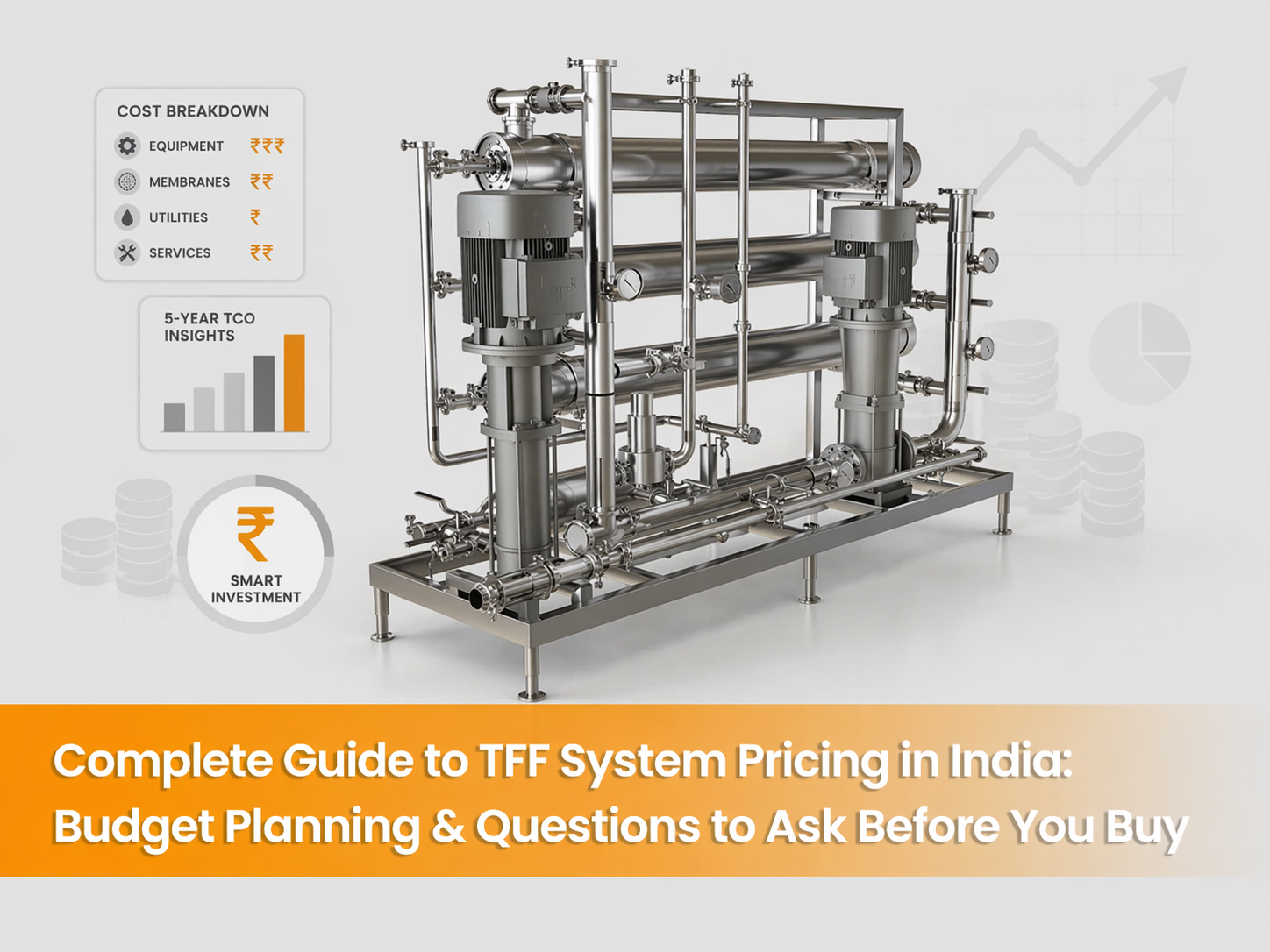
A typical imported TFF system from a global OEM at semi- production scale might be quoted at ₹1.5–2 Crore. A comparable Sanitech system might be ₹60–90 Lakh. But the acquisition price is just the beginning.
Cost Component (5-Year) | Imported System (Estimate) | Sanitech System (Estimate) |
Acquisition cost | ₹1.50 – 2.00 Crore | ₹0.60 – 0.90 Crore |
Import duty + customs + freight | ₹30 – 60 Lakh | Nil |
Lead time cost (delayed production) | 4–8 months revenue impact | 6–10 weeks, minimal impact |
Spare parts (5 years) | ₹15–25 Lakh (import-dependent) | ₹5–10 Lakh (domestic) |
Service / AMC (5 years) | ₹20–40 Lakh (OEM service) | ₹8–18 Lakh (Sanitech AMC) |
Membrane consumables (5 years) | Comparable (multi-vendor compatible) | Comparable (multi-vendor compatible) |
TOTAL 5-YEAR TCO (Estimate) | ₹2.15 – 3.25 Crore | ₹0.73 – 1.18 Crore |
Sanitech systems are built with multi-vendor membrane compatibility by design you are never locked into a single consumable supplier. This means your membrane costs are governed by the market, not by a sole-source relationship.
How to read a TFF quotation and what to watch for
A TFF quotation that looks cheap on the front page often has hidden gaps. Here is what your team should verify before approving any purchase:
1. Is the membrane included and at what area?
Membrane area determines throughput capacity. A system quoted without membranes is like a car quoted without an engine. Always ask: what MWCO, how many square feet of effective area, and is it included in the quoted price?
2. What is the automation level?
Semi-automatic systems (pressure gauges, manual valves, simple control panel) cost 30–40% less than PLC-automated systems. But for production-scale operations, PLC automation is essential for batch record integrity and regulatory compliance. Do not buy manual for a GMP line to save capital; you will pay more in labour and compliance risk.
3. Is FAT/SAT included?
Factory Acceptance Testing (FAT) confirms the system works before it leaves the manufacturer’s facility. Site Acceptance Testing (SAT) confirms it works at your site. Both should be in the scope. Ask for the FAT protocol upfront it tells you what the manufacturer is actually testing and committing to.
4. What are the utility requirements?
TFF systems need purified water (for CIP), electrical supply (3-phase for VFD pumps), chiller (to maintain process temperature) and floor drainage. If your facility needs upgrades to accommodate these, factor that into the project cost. Sanitech provides a utility requirements document as part of the pre-order package.
5. What is the warranty and post-warranty support model?
Ask: What is the warranty period? What does it cover (parts, labour, travel)? What is the response time commitment? Who is the local service contact? For Sanitech, the answer is: 12-month warranty, India-based service team, 24–48 hour response commitment, and an AMC option that covers both preventive maintenance and emergency callouts.
Financing and procurement options available in India
- Capital purchase with standard credit terms (30/60/90 days)
- Milestone-based payment (advance + delivery + commissioning) Sanitech standard
- Leasing / hire-purchase through NBFCs or equipment leasing companies
- Government subsidy eligibility MSME TUF scheme, DBT-BIO programs, state biotech park incentives (discuss with your finance team)
- Institutional purchase order (for universities, research institutes) Sanitech is registered with GeM portal
How to justify TFF to your management the numbers that work
If you are the person who knows TFF is the right answer but needs to build the business case upward, here is a framework that has worked for Sanitech customers:
The yield recovery calculation
Step 1: Calculate your current downstream yield (% of fermentation/extraction titre that reaches the final product.
Step 2: Estimate TFF yield (typically 90–96% for UF/DF vs 70–82% for centrifuge + dialysis).
Step 3: Multiply the yield improvement (%) by your annual production volume and product sale price per gram/litre.
Step 4: Add OPEX savings (energy, labour hours, membrane reuse vs consumables, batch turnaround time).
Step 5: Divide system cost by annual gain. That is your payback period.
A worked example whey protein concentration
Parameter | Current Process (Centrifuge + Evaporator) | With Sanitech TFF |
Annual feed volume | 500,000 L/year | 500,000 L/year |
Protein recovery | 72% | 94% |
Product value (WPC-35) | ₹180/kg | ₹180/kg |
Annual product yield (kg) | ~8,640 kg | ~11,280 kg |
Revenue from product | ₹1.56 Crore/year | ₹2.03 Crore/year |
Additional annual revenue | – | +₹47 Lakh/year |
Sanitech system cost (indicative) | – | ₹55–90 Lakh |
Simple payback period | – | 18–20 months |
This is a conservative example using a mid-value product. For pharmaceutical proteins, enzymes, or specialty nutraceuticals, payback periods of nearing 1 yr are common.
What the lab trial gives you before you commit
Sanitech’s lab trial is specifically designed to generate the numbers you need for your internal business case. In a typical 1–2 day trial at our facility, you receive:
- Flux data (LMH) at your process conditions
- Yield data (% product recovery at your target concentration factor)
- Membrane selection recommendation with rationale
- Scale-up parameters for pilot and production
- Indicative system specification and budgetary quote
- Clean-in-place protocol draft
This is not a demo. It is a process development exercise with your actual product. You own the data with minimal investment.
Conclusion
Investing in a TFF system is not just a capital decision, it is a strategic move to improve yield, reduce losses, and optimize long-term operational efficiency. The right evaluation of pricing, system design, and total cost of ownership ensures that you choose a solution aligned with your process and growth plans.
If you are planning to implement a tangential flow filtration system, focus on data, validate through trials, and make a decision based on measurable returns rather than just upfront cost.
FAQs
No. Sanitech builds single systems, from lab scale upward. We are not a mass manufacturer. Every system is engineered for your application.
Yes, and this is the path we recommend for first-time TFF adopters. Start with a lab skid (₹10–12 Lakh), validate your process, build your internal case, then commission a pilot or production system with confidence. The process parameters transfer directly.
Sanitech systems are 40–65% lower in acquisition cost vs equivalent-specification systems from global OEMs before factoring in import duties, freight, and service costs. The performance is equivalent; we use internationally compatible components and the same membrane chemistry. The difference is that we manufacture in India, with India-specific support infrastructure.
Since we are not membrane manufacturers, we keep multiple makes of membrane to support our customers with desired product specifications. In rental cases, handing over membrane banks becomes a costly affair and it is suggested to have trials at our facility
Yes, and we encourage it. Seeing how your system is built is part of the qualification process. Sanitech's manufacturing facility is open for customer visits by appointment.
Get a Budgetary Quote in 48 Hours
Tell us your application, your scale, and your timeline. We will send you a detailed budgetary quotation, line-itemized, with options within 48 business hours. No vague price ranges. No ‘it depends’. A real number you can take to your finance team.
And if you want to validate the numbers before you buy our lab trial gives you the yield and flux data to build an ironclad business case.
BOOK A LAB TRIAL OR REQUEST A QUOTE
With minimal investment
Lab trial: Bring your product. Get your data. Make your decision.
Quote: Tell us your scale and application. Receive a detailed budgetary quote in 48 hours.