
Introduction
Most dairy plants are sitting on revenue they don’t know about. Every hour, valuable proteins, lactose, and clean water leave your facility through the effluent line – unrecovered, unmonetised, and unnoticed. Membrane technology stops that from happening. It captures what your process is already producing and converts it into ingredients, savings, and sustainability gains that show up directly on your P&L.
In this blog, we walk you through five proven opportunities where membrane separation delivers real financial returns, backed by plant-level data and clear payback timelines. If you are a dairy leader making capital investment decisions, this is the clearest picture you will get of what your whey stream is actually worth.
In a 5,000 L/hr dairy plant processing sweet cheese whey, approximately 4,800 litres of UF permeate flows away every hour. Inside that stream: 4.8% lactose, residual minerals, and enough recoverable value, if processed correctly, to generate ₹3–8 crore per year in additional revenue. At most Indian dairy operations today, that stream goes to the effluent treatment plant.
This is not a technical problem. It is a strategic decision that every dairy VP and Director makes; often by not making it.
Membrane technology does not cost money. It recovers money that is already leaving your plant – every hour, every shift, every day of the year.
This blog is written for the dairy industry leader who is evaluating capital investment decisions, answering to a board about OPEX efficiency, or preparing a sustainability report. We will show you, using real process data, exactly what membrane separation can return to your P&L.
The Five Revenue Opportunities Hidden in Your Dairy Process
Modern dairy membrane technology addresses ten distinct unit operations. For a business leader, five of these have immediate, quantifiable revenue impact.
1. Whey Protein Concentrate (WPC): Converting a Cost Centre into a Profit Centre
Sweet cheese whey arrives at 0.65% protein. After ceramic microfiltration to remove fat followed by ultrafiltration, that protein concentrates to 16% in the retentate. With diafiltration (2–4 volumes), the final product is WPC-80: 80% protein on a dry solids basis.
Product | Protein % | Yield (kg/hr @ 5000 L/hr feed) | Market Value (₹/kg) |
WPC-35 | 35% | ~80–90 kg/hr | ₹180–250/kg |
WPC-80 | 80% | ~40–45 kg/hr | ₹350–500/kg |
WPC-80 (export) | 80% | ~40–45 kg/hr | USD 4–7/kg |
2. Milk Protein Concentrate (MPC): Standardisation Margin
Ultrafiltration of skim milk with diafiltration produces MPC-40, MPC-70, and MPC-85; these serve as the building blocks for infant formula, sports nutrition, functional foods, and premium dairy ingredients. The commercial opportunity is significant: MPC-85 commands ₹800–1,200/kg in domestic markets and significantly more for export-grade product.
At 5,000 L/hr skim milk feed, a UF system operating at 20–60 LMH flux can produce approximately 190–220 kg/hr of spray-dry-ready MPC-85 liquid concentrate. The diafiltration step (2–8 volumes of RO-quality water) removes lactose and minerals to achieve the target protein ratio on total solids.
- MPC-40: 20× concentration factor, no diafiltration – the lowest-cost entry point
- MPC-70: 20× CF + 2 diafiltration volumes – mid-range sports nutrition ingredient
- MPC-85: 20× CF + 5–8 diafiltration volumes – premium infant formula and pharmaceutical grade
3. Lactose: The Forgotten Commodity in Every UF Permeate Stream
Every kilogram of WPC-80 or MPC-85 you produce also generates a UF permeate containing 4.5–5.0% lactose. From a 5,000 L/hr feed, approximately 4,800 L/hr of permeate carries ~230 kg/hr of dissolved lactose. Nanofiltration (NF, 96–99% lactose rejection) concentrates this to 220–300 g/L in the retentate at 4–6× concentration factor.
The concentrated lactose stream feeds a crystalliser to produce α-lactose monohydrate, resulting in pharmaceutical-grade lactose at ₹60–120/kg, or food-grade lactose at ₹25–45/kg. The NF permeate, low in lactose, undergoes a final RO polishing step for process water recovery (>96,000 L/day of clean water at 80% recovery).
4. Caustic Recovery: The Most Ignored OPEX Lever in Dairy
A typical 5,000 L/hr dairy operation runs CIP cycles consuming 500–1,500 litres of 0.5–1.0% NaOH solution per cycle, multiple times daily. At current NaOH prices (₹25–35/kg as commercial lye), annual caustic consumption at a mid-size plant runs ₹30–60 lakhs per year. Between 60–80% of this is recoverable.
Ceramic microfiltration of CIP caustic return streams (pH 11–14, 60–80°C) recovers >85% of the NaOH in the permeate, removing suspended dairy solids (TSS reduced from 1–5 g/L to <0.01 g/L). The recovered caustic requires only 5–15% top-up to return to operating strength, allowing for 10–30 reuse cycles per charge. A suitable Caustic Recovery System for dairy must withstand high pH and temperature conditions to enable effective NaOH recovery and reuse.
CFO’s Number: Caustic Recovery ROI
Annual caustic saving at 70% recovery from ₹50L/yr spend: ₹35 Lakhs/year saved. System cost (25–100 m² ceramic MF skid): ~₹30–50 Lakhs installed. Payback: 6–12 months. Additionally: wastewater COD reduced by 50,000–100,000 mg/L in the retentate stream, significantly cutting ETP operating costs.
5. Process Water Recovery: Sustainability That Pays
Recovering 80% of 5,000 L/hr membrane permeate through RO polishing yields approximately 4,000 L/hr (or 96,000 litres per day) of water meeting the quality requirements for diafiltration, CIP rinse water, and utility use. At municipal water costs in industrial zones (₹25–40/kL), this represents a direct annual saving of ₹35–56 lakhs/year, before accounting for wastewater treatment cost avoided.
Why Indian Dairy Plants Are Investing in Membrane Technology Now
Three converging forces make membrane investment a board-level priority today, not a future-state aspiration.
First, regulatory pressure is tightening. CPCB norms on dairy effluent ( specifically COD, BOD, TSS discharge limits) are increasingly enforced. Dairy effluent untreated carries COD of 1,500–20,000 mg/L. Membrane separation of valuable streams before ETP reduces COD load by 60–80%, fundamentally changing your environmental compliance economics.
Second, the export opportunity is real. Indian WPC-80 and MPC-85 are price-competitive with New Zealand and European products when manufactured to export specifications. Systems are backed by full IQ, OQ, PQ validation and GMP-compliant documentation, a baseline requirement for export-grade ingredient supply.
Third, domestic premium dairy ingredients are growing at 12–18% CAGR, driven by sports nutrition, infant formula, and functional food formulation demand. The brands consuming MPC-85 and WPC-80 are growing faster than your current commodity milk processing margins.
What Sanitech Engineers Brings to Your Boardroom
Sanitech Engineers Pvt. Ltd. has designed and delivered membrane separation systems across pharma, dairy, and industrial applications for over three decades. For the dairy industry specifically, we offer:
- Complete process design – from mass balance and P&ID to commissioning and operator training
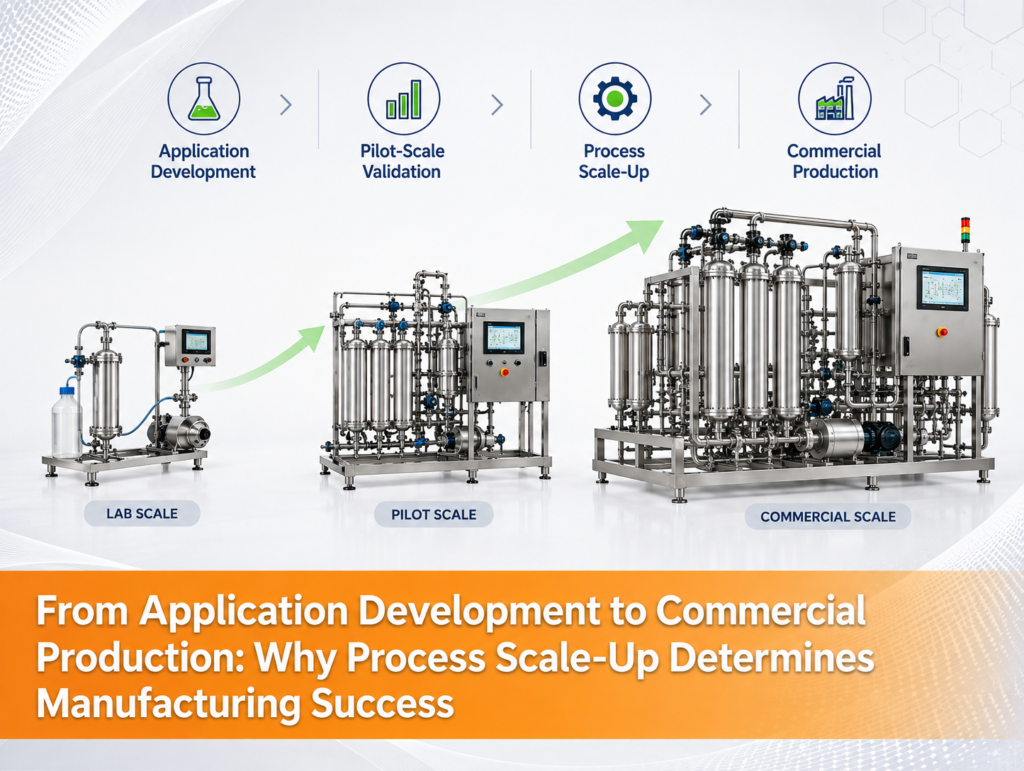
- Lab-scale to commercial scale: bench trials at 0.16 m² to commercial systems at 500+ m²
- Feasibility study with minimum investment – send us 25 L of your whey or milk, and we return a process solution
- Make-in-India manufacturing – systems fabricated in our Mumbai facility to ASME BPE standards
- All systems are delivered with PLC, SCADA, and HMI-based automation, ensuring seamless integration with your existing plant operations.
- Full project accountability – one contract covers design, fabrication, installation, commissioning, and AMC
The First Step Costs Nothing
Sanitech offers every dairy director a complimentary process feasibility consultation, no commitment required. In 90 minutes, we can map your existing streams against the ten membrane unit operations, identify the top three revenue and cost-reduction opportunities specific to your plant, and give you a capital and payback estimate you can take to your board.
Conclusion
The revenue is already there. It flows through your plant every hour, in every shift, every day of the year. Membrane technology does not create a new business. It recovers value from the one you already have. The five opportunities covered in this blog represent a realistic, proven path to stronger margins, lower effluent costs, and a more sustainable operation. The numbers are not projections. They reflect what the technology delivers at plant scale, with commercially available systems and well-established processes.
For a dairy leader evaluating capital investment decisions, the question is straightforward. The value is quantifiable, the payback timelines are short, and the technology is mature. What remains is the decision to act on it.
FAQs
Yes. Our low shear pumping system are specifically designed for shear-sensitive products (enveloped viruses, certain cells, fragile proteins). The laminar flow applies minimal mechanical stress. We help you select the right membrane and module geometry for your molecule.
Our lab-scale systems handle feeds from 500 mL to 5 L. Pilot systems from 15 L to 50 L. Semi-Pilot systems from 50 L to 250 L. Production skids from 250 L to 5000+ L. We help you define the right starting scale and build your scalability roadmap.
This is the core strength of TFF. Sanitech designs lab and production skids on the same process basis same TMP targets, same crossflow velocity, same membrane chemistry. Scale-up is a matter of membrane area, not a new process development exercise.
Properly cleaned and stored membranes run 50 to 100+ cycles in validated pharma processes. We provide flux testing protocols and cleaning SOP documentation. Membrane reuse is a major OPEX advantage over centrifuge rotors or single-use depth filters.
Yes. All Sanitech TFF systems are designed and built to cGMP standards. We provide IQ/OQ documentation, material certificates (SS316L contact parts), and full traceability. Systems are designed for FDA/WHO inspectable facilities.