A successful laboratory process proves that a molecule can be made. A successful scale-up proves that it can be manufactured. Every breakthrough product starts the same way: with a promising result on a lab bench.
Researchers spend months, sometimes years, fine-tuning reaction conditions, fermentation parameters, purification strategies, and analytical methods until they get the product they’re after. That lab-scale success proves the science works. It gives everyone confidence that the process is real.
But it’s only the beginning.
The real test comes when that same process has to be repeated, reliably, at pilot and then commercial scale.
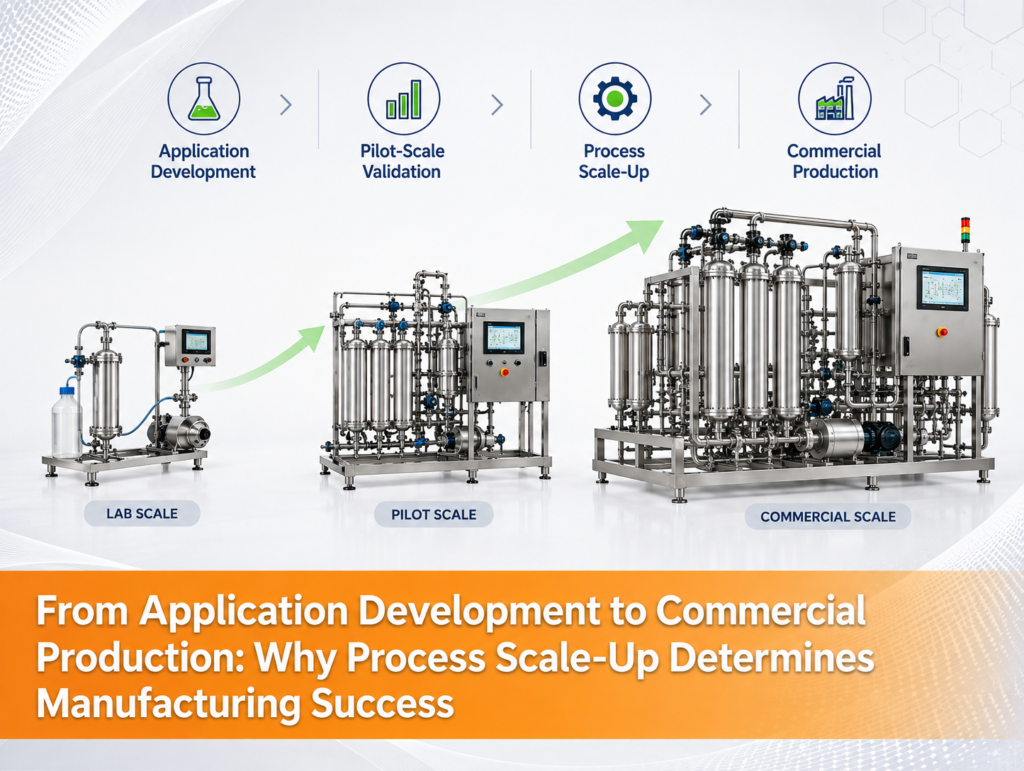
Across pharma and biopharma, most manufacturing headaches don’t actually start in the lab. They show up during process scale-up. A process that gives you great recovery, purity, and productivity in a 5-litre system can behave completely differently once you push it to 500 litres, or 5,000.
What separates a promising molecule from a commercially successful product usually comes down to one thing:
Why Scale-Up Is So Challenging
Scaling up isn’t just a matter of using bigger equipment. As production volumes grow, the underlying process dynamics shift, sometimes in ways that are hard to predict. Parameters that were simple to control at lab scale can become genuinely difficult to hold steady in a larger system.
Engineers have to account for changes in things like:
- Flow distribution
- Pressure drop
- Residence time
- Mixing efficiency
- Mass transfer
- Heat transfer
- Membrane flux behaviour
- Chromatography loading capacity
- Cleaning and sterilization requirements
Even small shifts in these variables can meaningfully affect product quality, recovery, throughput, and cost. A process that looked rock-solid in the lab can suddenly run into bottlenecks the moment production actually starts.
Why Laboratory Success Doesn't Guarantee Manufacturing Success
One of the most common assumptions in this industry is that a process that works in the lab will simply keep working once it’s scaled up. In practice, scale-up brings its own set of engineering problems that have nothing to do with the original science.
A few examples:
- A Tangential Flow Filtration (TFF) process that holds stable flux on the benchtop can start fouling rapidly at scale if crossflow velocity and transmembrane pressure aren’t carefully maintained.
- A preparative chromatography process that separates beautifully in a lab column can lose resolution at production scale if column packing, flow distribution, or loading conditions aren’t dialled in properly.
- A fermentation process with excellent titres can still fall short commercially if recovery drops during large-scale downstream purification.
None of these are equipment failures. They’re process engineering challenges, and they need to be treated as such.
Five Common Scale-Up Mistakes
A lot of scale-up projects run into trouble they didn’t have to, simply because a few critical variables got overlooked. Here are the ones we see most often.
Mistake one: Scaling Equipment Instead of Process Parameters Making the system bigger without holding on to the operating conditions that made it work in the first place is one of the fastest ways to end up with inconsistent performance.
Mistake two: Selecting Equipment Too Early Locking in membranes or chromatography systems before you truly understand the process tends to limit your options later, and drive up costs down the line.
Mistake three: Skipping Pilot Validation Jumping straight from lab trials to commercial production sounds efficient, but it dramatically raises both the technical and financial risk.
Mistake four: Ignoring Process Economics Recovery, solvent consumption, membrane life, resin utilization, cleaning cycles, and operating costs all need to be worked out during development, not discovered after the equipment is already installed.
Mistake five: Designing for Today Instead of Tomorrow A process built only for current volumes tends to require a costly redesign the moment demand grows. Building in room to expand from the start saves that pain later.
Why Process Development Comes First
Manufacturing success at commercial scale is decided well before the first production batch ever runs. Process development is what lays that groundwork.
At this stage, manufacturers work through:
- Product characteristics
- Feed composition
- Purification strategy
- Membrane selection
- Chromatography media
- Operating conditions
- Recovery targets
- Product purity
- Process reproducibility
Getting this right early on removes a lot of guesswork and sets up better performance down the line. It also saves manufacturers from expensive rework after the commercial system is already in place.
The Critical Role of Pilot-Scale Validation
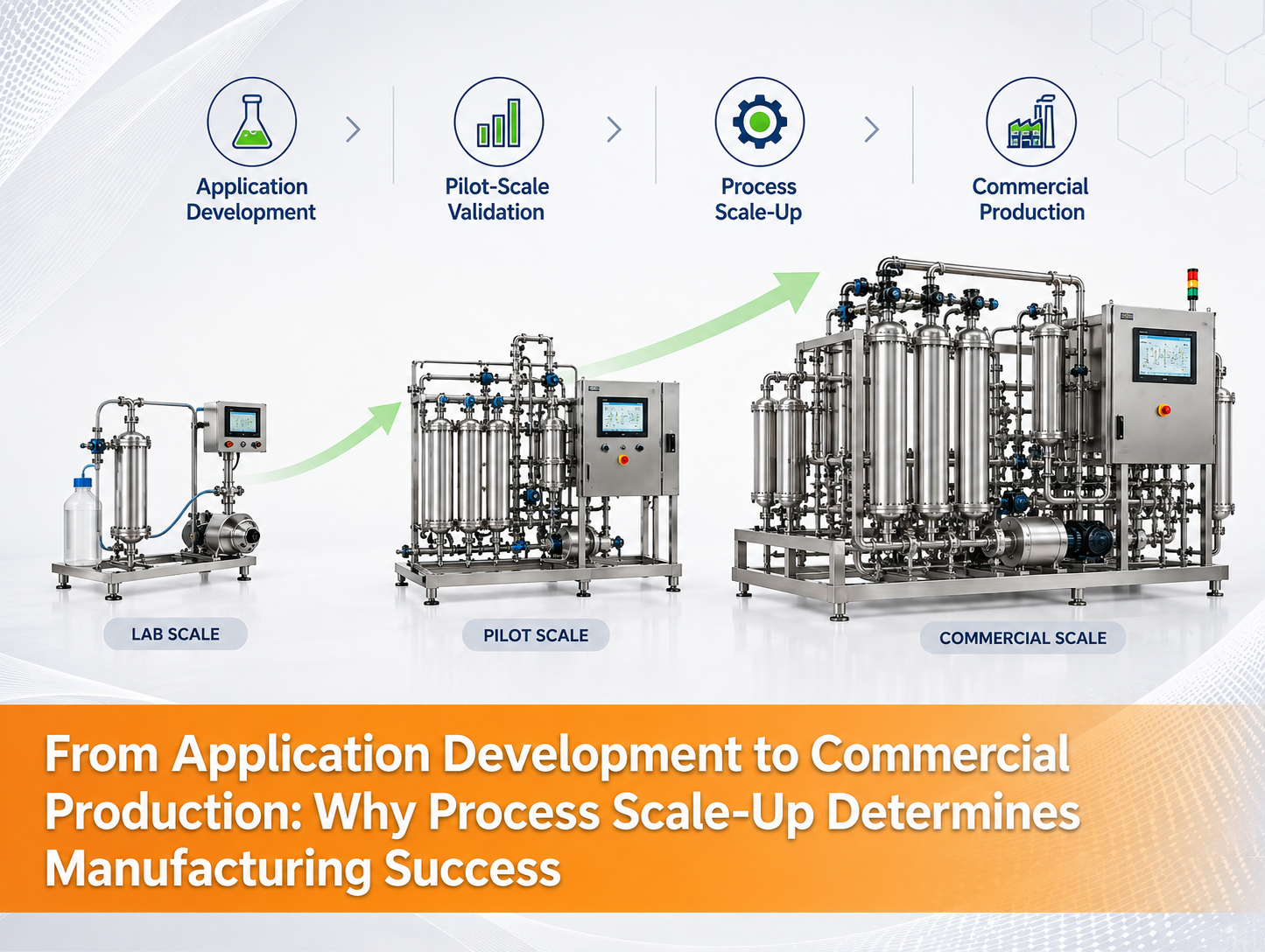
Pilot-scale systems are the bridge between lab research and full commercial manufacturing. They let manufacturers see how the process actually performs under conditions much closer to real production.
A solid pilot study helps confirm:
- Product recovery
- Product quality
- Membrane performance
- Chromatography efficiency
- Pressure behaviour
- Cleaning strategy
- Automation philosophy
- Process economics
- Scale-up feasibility
Doing this work at pilot scale meaningfully lowers risk and gives everyone more confidence before committing to a major capital investment.
Engineering for Scalability
Scalability isn’t something you bolt on later. It needs to be built into the process from day one.
A scale-up strategy that actually works takes into account:
- Modular system architecture
- Automation requirements
- GMP compliance
- CIP and SIP compatibility
- Validation requirements
- Future production capacity
- Utility consumption
- Ease of maintenance
- Operational flexibility
The goal isn’t just to make more of the product. It’s to make the same high-quality product, batch after batch, efficiently and economically.
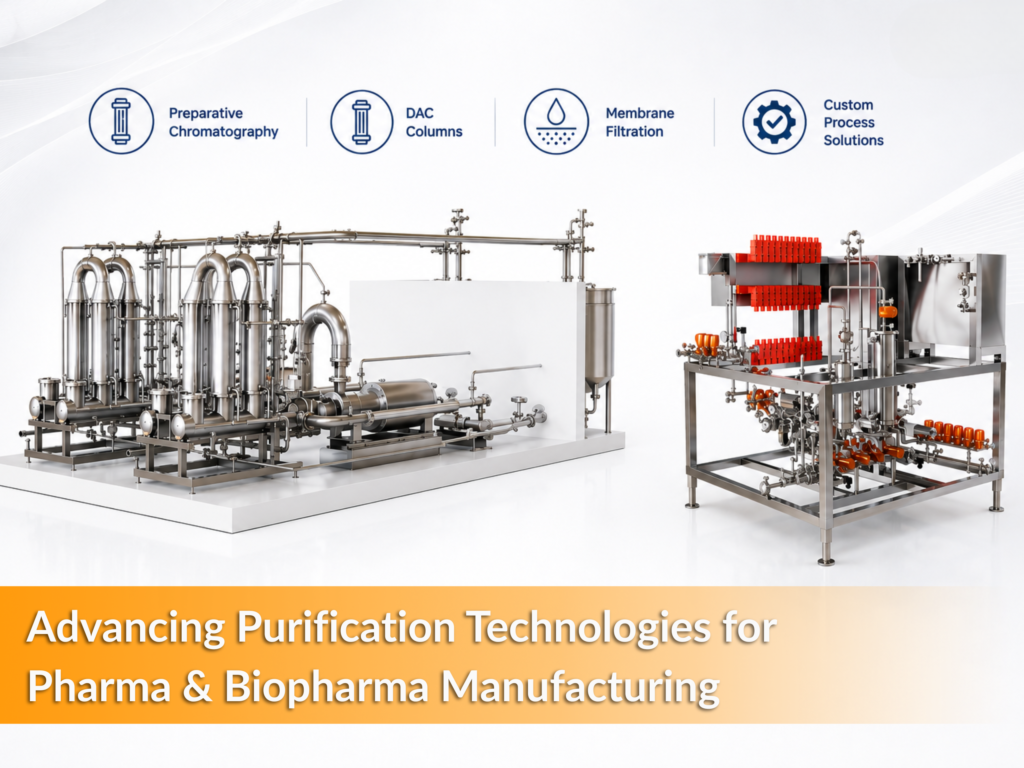
Scale-Up in Membrane Filtration and Preparative Chromatography
Both technologies play a role in downstream purification, but scaling each one up comes with its own considerations.
Membrane Filtration
Getting membrane scale-up right means carefully managing:
- Crossflow velocity
- Transmembrane pressure (TMP)
- Membrane loading
- Flux behaviour
- Fouling characteristics
- Cleaning cycles
Keeping these parameters under control is what keeps recovery consistent and membrane life where it should be.
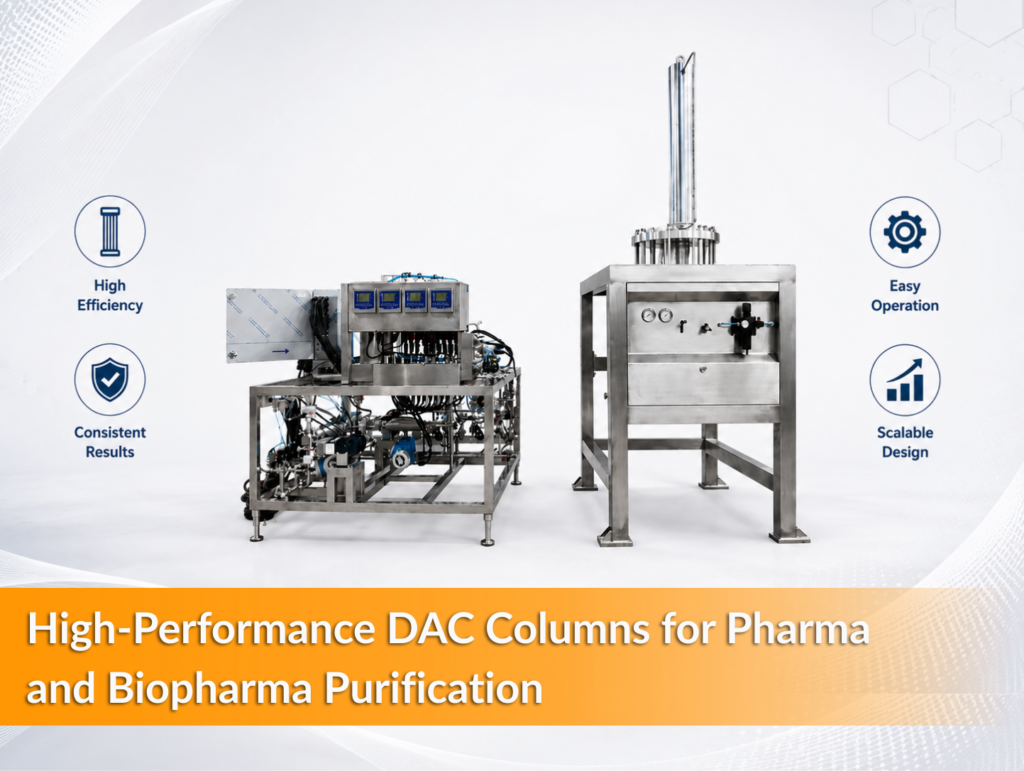
Preparative Chromatography
For preparative chromatography systems, the variables engineers need to optimize include:
- Column diameter
- Bed height
- Resin selection
- Column packing quality
- Flow distribution
- Sample loading
- Elution strategy
Even small deviations here can throw off resolution, productivity, and solvent use.
Collaboration Drives Successful Commercialization
Scale-up isn’t purely an engineering exercise. It works best as a team effort involving:
- Scientists
- Process Engineers
- Manufacturing Teams
- Quality & Validation Specialists
- Operations Leaders
When these groups are involved from the earliest stages of development, projects move faster and carry a lot less risk.
From Process Development to Commercial Production
At Sanitech Engineers, we start with the process, not the equipment catalogue.
Our engineering team works alongside customers from the earliest stages of process development, right through pilot validation and into commercial implementation.
Here’s what we bring to the table:
- Process Development & Application Trials
- Membrane Filtration Systems
- Tangential Flow Filtration (TFF)
- Preparative Chromatography Systems
- Pilot-Scale Validation
- Process Optimization
- Commercial System Engineering
- Automation & GMP-Compliant Solutions
Rather than handing customers standard, off-the-shelf equipment, we build integrated purification solutions designed specifically around their product, their process, and their production goals.
Looking Ahead
As pharmaceutical manufacturing keeps moving toward biologics, precision medicine, continuous processing, and more sustainable production, getting scale-up right is only going to matter more.
Manufacturers who invest in strong process development and engineering now will be in a much better position to:
- Reduce technical risk
- Improve product recovery
- Increase manufacturing efficiency
- Accelerate commercialization
- Lower lifecycle costs
- Deliver consistent product quality
Innovation in pharma starts in the lab. Commercial success starts with scale-up.
Ready to Scale Your Process with Confidence?
Whether you’re developing a new purification process, fine-tuning an existing manufacturing line, or gearing up for commercial production, Sanitech Engineers can help you bridge the gap between lab-scale innovation and large-scale manufacturing.
Let’s work together to engineer a scalable purification process that delivers consistent quality, higher recovery, and long-term manufacturing success. Contact us to discuss your scale-up project.